Sabtu, 15 Oktober 2016

NO ROOT version of Toggle Mod v10.1 - Bugs Fixed - Mind Blowing Features - Mini Militia v2.2.86 for non rooted Android devices

Hello boys,

As always, I kept ma promise by releasing this "No Root Version Of Toggle Mod For Mini Militia v2.2.86" works with every non rooted Android devices, combined with awesome new features.

***IMPORTANT NOTE***
DO NOT EVER COPY OR MODIFY MY APPLICATIONS IN ANY MANNER AND NEVER HOST MY APPLICATIONS WITHOUT MY WRITTEN PERMISSION.

Let's jump in.


What are the Features?

Includes all features from the latest version of Toggle Mod v10.1 -  http://djadrianlivenewclubmuzic.blogspot.com /2016/10/toggle-mod-v10.1-bug-fixes-mini-militia-v2.2.86.html" target="_blank">http://www.djadrianlivenewclubmuzic.blogspot.com/2016/10/toggle-mod-v10.1-bug-fixes-mini-militia-v2.2.86.html , which is meant for rooted phones.

How to install? - (For users who knows my Toggle Apps before)

  1. Download the app from the Downloads section below.
  2. Install the downloaded "MiniMilitiaMods-RevealedTricks4U.com-NOROOT.apk" file.
  3. That's it.

How to install? - (For new users)

  1. Download the app from the Downloads section below.
  2. Uninstall any previous version of "No Root Toggle Mod App". (App Signature changed)
  3. Install the downloaded "MiniMilitiaMods-RevealedTricks4U.com-NOROOT-v10.1.apk" file.
  4. Make sure you have already installed the latest game "Mini Militia - Doodle Army 2". It is version 2.2.86, at the time of writing.
  5. Now open the game at least once. Just quit the game, after seeing the home screen.
  6. Open the "ToggleMod" app.
  7. Select your desired options.
  8. Just press the button "Patch", then sit back and relax, until the whole operation completes. It would take around 1-5 minutes, according to your device's performance.
  9. Now, you would be asked for replacing the installed game app. Make sure you have already took a recent backup of your game before proceeding with this.
  10. Just press the button "Nail it!", and press "Un-install" and then "Install".
  11. That's it. Now press button "Launch Game", back in the app and enjoy the gameplay ;).
NOTE - IF YOU'VE ALREADY PATCHED AT LEAST ONCE WITH THIS APP, THEN YOU DON'T HAVE TO UNINSTALL FOR FUTURE PATCHES, JUST PRESS CANCEL, AT THE UNINSTALL WINDOW.

Downloads

Bug Fixes

  • There was a typing error in the code, that causes "Problem parsing package". - I would really like to thank you all, for reporting this withing a matter of seconds.

All I am asking you is "Share and Subscribe" ;).

Please feel free to leave your comments, If any problem persists.
Read more

Jumat, 14 Oktober 2016

Around the Brexit Blogs and Related Events


InternKat searches for the latest updates...
 1. Afro-IP: Similarity Tools, Bug Bears and Brexit
The Afro-IP blog, covering African intellectual property law, informs readers that in the past the Republic of South Africa have looked to the UK when interpreting their Trade Mark Law. However, as the European system has developed, the South African courts have considered the decisions of the CJEU. Afro-Leo believes that the European influence in the interpretation of the ‘likelihood of confusion’ test is likely to prevail in Africa. However, he ponders whether after Brexit Africa will take direction from the UK or the CJEU.

2.
 SOLO IP: Why you should withdraw your European Patent Application
SOLO IP, blogging for Independent IP Practitioners, suggests that patent applicants and their agents should very seriously consider their portfolios of pending European patent applications. Barbara Cookson submits that the prospect of the Unitary Patent is fading fast after the Brexit vote and advises readers that examination fees will be refunded if examination has not started.

3.
  MARQUES CLASS 99 (Designs: A different sort of Brexit: London Act is terminated.
Marques Class 99, blogging on design law, informs readers of the Termination of the London (1934) Act of the Hague Agreement Concerning the International Deposit of Industrial Designs. This may be of more historical than commercial interest to many readers since the termination has been in process since 2013. 

Two related events:
1.  Is there a European Future for UK Intellectual Property Law?
The CIPPM Annual Symposium 2016 will address the uncertainties that surround the forthcoming role of UK in the European intellectual property arena, in an attempt to respond to some of the questions that have emerged in the wake of the referendum. Where: Executive Business Centre, Bournemouth University When: Thursday 3 November 2016, 10.30 – 18.00. 

2.
 Copyright Reform in a Brexit Environment, Public Lecture By Prof. Martin Kretschmer
The CREATe Public Lecture Series 2016 will investigate what a digital single market means in an interconnected world in which copyright still slices content by territory; and whether the balance between artists, investors and users still reflects an analogue world of linear exploitation. The lecture then considers if the UK will become a digital Island post Brexit. Where: University of Glasgow, Humanities Lecture Theatre When: Wednesday, October 19th, 17:30
Read more

The Reason Why Video Entertainment is The Only Service To Increase Prices

Over the past several decades, it would have been a reasonable question to ask why entertainment video service prices grew faster than inflation, while retail prices for communications services (voice, texting, Internet access) declined, either on a price-per-unit basis or in terms of absolute price per unit.

The answer is simple: entertainment video is about the purchase of content, not access to content.

Compared to voice, texting or Internet access, entertainment video is more akin to fashion than a utility service. And that means retail price is not a direct function of production cost.

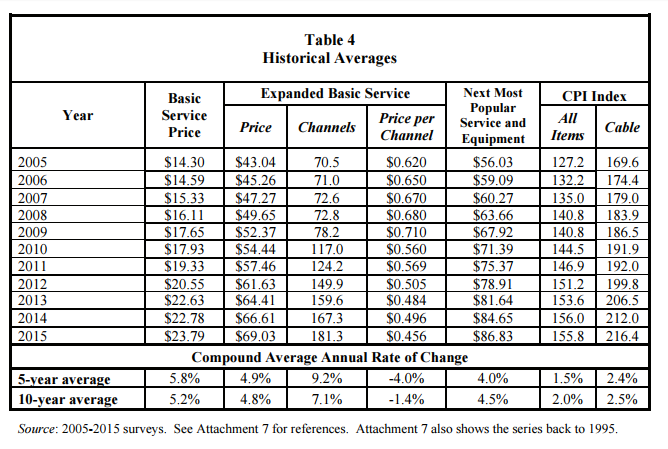
That is clear in the latest Federal Communications Commission report on content prices in the U.S. linear video market.

However, given diminished consumer appetite for the traditional “big content bundles” and a shift to over-the-top or on-demand viewing, it will be necessary for most, if not all, providers to “just say no” to content providers and restrict the size of bundles.

That is going to shift the way content gets to market, with increasing amounts of programming moving through new services such as Netflix and Amazon Prime.

According to a new FCC report, the average monthly price of expanded basic service (the combined price of basic service and the most subscribed cable programming tier excluding taxes, fees, and customer premises equipment charges) for the communities surveyed grew by 2.7 percent over the 12 months ending January 1, 2015, to $69.03, compared to a decrease of 0.1 percent in the consumer price index.

That is to say, linear video prices rose by an order of magnitude more than the overall level of consumer prices.

This compares to a compound ten-year average rate of increase from 2005 to 2015 of 4.8 percent in the price of expanded basic and a 1.5 percent increase in the CPI.

To be sure, linear video providers have argued in the past that prices are up in large part because the number of channels offered in bundles has grown.

The price per channel (price divided by number of channels) for subscribers purchasing expanded basic service decreased by 1.8 percent over the 12 months ending January 1, 2015, to 46 cents per channel.

Over the 10 years from 2005-2015, the price per channel has declined by 1.4 percent on an average annual compound basis.

In the past, consumers might not have had as much choice. In the future, they will. Prices are going to come down. Still, the issue is whether entertainment video might still outperform voice, texting or Internet access, in some cases, in terms of absolute revenue contribution, price per unit or profit margin.


Read more

Google Will Go "Mobile First" for Search

The business strategy known as mobile-first is affecting Google’s continued development of its search business.

Google is going to create a separate mobile index within months, becoming the main or “primary” index that the search engine uses to respond to queries.

A separate desktop index will be maintained, but will not be as up-to-date as the mobile index, it is expected.
Read more

Is there a competition law issue lurking on the horizon of cloud computing?


Are we on the cusp of a potential competition law problem in the area of cloud computing services? The Economist tantalizingly, in an article entitled “Cloud Chronicles”, which appeared in its August 27th issue, has described the present circumstances of the industry, and why there might be room for future competition law concern. The culprit, if it comes to pass, may well be Amazon Web Services (usually referred to as AWS), which is the cloud-computing part of Amazon.com. The story goes like this.

In 2006, Amazon made available a beta version of a service called “Elastic Compute Cloud”, described as
“the central offering” of AWS. The service took off, in part, according to the article, because it coincided with the rise of the smartphone and the supporting app industry. Developers loved the opportunity to forego maintaining a hardware system and paying a fixed fee for use of software, in favor of paying only for the capacity that they used. AWS is said to have engaged in “many rounds of price reductions”, enabling it to capture increased market share. As well, AWS has, and continues to offer, an increasing number of add-on services, the marginal cost for which is minimal since the software has already been developed.

As such, AWS early on enjoyed first mover advantage (being the first cloud computing service “to succeed on a large scale”) and continues to benefit from network effects. As well, the burden of switching costs served to make it more likely that a user will be reluctant to move to another cloud service. Based on these advantages, AWS has raced far ahead of its competition. It is three times larger than its nearest competitor—Microsoft Azure. Other potential competitors are even less visible, including competing offerings from IBM and Google. At least these two hi-tech behemoths are still in the game; Hewlett-Packard has apparently simply withdrawn from the field. Even Salesforce.com, which is a prominent provider of on-line applications, announced that it will begin to make use of AWS services.

What will slow AWS’s continued dominant position in the industry? The article suggests that users are aggressive in trying to avoid being locked-in to AWS as their sole cloud services provider. It further reports that, at least in Europe, two-fifths of the companies in the cloud use more than one cloud service. Also, while the AWS service is highly popular with start-up developers, it has less success in attracting larger, established companies, in part, it would seem, from a hesitation by such companies to be tied up with a potential competitor, given the ever-increasing nature of Amazon’s product and service offerings. These countervailing forces argue that there may be a limit as to how much more AWS can grow.

Still, based on the information in the article, AWS does seem to enjoy a dominant position with smaller developers. If this were to be found to be the relevant population for vetting competition law concerns, then attention to pricing (should prices begin to tick upwards) and the ease or difficulty of switching to another cloud service, bears watch, especially since the computing infrastructure required might serve as a potential barrier to entry for competitors. Or perhaps less conventional metrics will be brought to bear. The article itself does not go into a discussion of how anti-competitive behavior by AWS might look, stating merely that—
“AWS could end up dominating the IT industry just as IBM’s System/360, a family of mainframe computers, did until the 1980s. If that happens, the antitrust authorities may eventually have to step in, as they did with IBM.”
This in itself is an interesting comment. This Kat is hoary enough to remember the antitrust case against IBM, filed in 1969, which dragged on until 1982. There, the issue was IBM’s alleged anti-competitive conduct based on its alleged dominance of the mainframe computer industry. What is notable is that this decade-long lawsuit came to an end because the US Depart of Justice ultimately decided to dismiss the case. Developments in the computer world had moved on since the filing of the law suit in the late 1960’s, and the capacity of IBM to dominate the computer world had passed.

Even more, this Kat remembers the frequently made comment that antitrust suits such as the IBM case, especially in the technology area, are almost always late to the game: either the technology is passing the target industry by, or the law suit is a cue to the target to seek new products and markets. If this be true, then it raises an interesting question: what would the filing of such a law suit say about the cloud-computing industry? Is the pace of innovation so seriously stuck in neutral, and the nature of cloud-computing so very different from the world of IBM’s System/ 360 family of mainframe computers, that there might be greater justification in considering such a law suit, should there be prima facie indicia of anti-competitive behavior? Or will such a suit be a redux of the IBM litigation? Stay tuned (especially if your computing connectivity is from the cloud).
Read more

Kamis, 13 Oktober 2016

Video & Photo Gallery: Unboxing Umi Super 4G Phablet

http://www.efox-shop.com/umi-super-4gb-ram-32gb-rom-touch-id-4000mah-helio-p10-mtk6755-20ghz-octa-core-55-zoll-25d-cornin-g-305438

You can now buy Umi Super 4G Phablet from Efox-Shop.com for only 164.99 Euro if you use this coupon code: USD5 (regular price: 169.99 Euro). 

Inside the UMi Super you’ll find one of the latest MediaTek Octa-Core Mobile Processors, 4GBs of RAM, 32GBs of Samsung eMMC storage, an ARM Mali-860 Dual-Core GPU, Full HD Screen, a great battery and to top it all off it even includes a fingerprint sensor. 

UMi Super brings you the best of both worlds: a huge FHD screen on an superb metal body that fits like a glove in one hand. In fact, thanks to its almost invisible bezel and high screen-to-body ratio, it's noticeably more compact than other 5.5' screen smartphones. 

Powered by the brand-new Helio P10 Octa-core processor from Mediatek, the Cortex-A53 CPU and the ARM Mali-T860 MP2 700MHz complement each other perfectly, resulting in an unexpected high Antutu score. With SAMSUNG eMMC 5.1 flash memory and ultra-large 4GB RAM, UMi Super can easily handle all situations and perform incredible fast. 

Taking inspiration from professional-grade Hi-Fi system, UMi Super's dedicated sound card renders every frequency in stunning detail and transforms your music with cleaer vocals,better defind instrumental passages and deeper bass. Discover a level of music that you've never heard before with minimal-loss,studio-grade sound quality. 
  
Umi Super 4G Phablet Features
●  Display: 5.5 inch 1920 x 1080 FHD Corning Gorilla Glass 3 screen 
●  CPU: Helio P10 (Mediatek MTK6755) 64bit Octa Core 2.0GHz 
●  GPU: Mali-T860MP2
●  System: Android 6.0 
●  RAM + ROM: 4GB RAM + 32GB ROM 
●  Camera: Front camera 5MP + Rear camera 13MP with auto focus and Dual Flash (Dual color temperature)
●  Bluetooth: 4.1 
●  GPS: GPS
●  Sensor: G- Sensor, Glonass, P- Sensor, L-Sensor, Accelerometer, Compass 
●  Features: Type-C interface, OTG, HiFi, etc. 
●  SIM Card: Dual sim dual standby 
● Network: WiFi: 802.11 a/b/g/n 2.4GHz/5GHz, 2G: GSM 900/1800/1900MHz, 3G: WCDMA 850/900/1900/2100MHz & 4G: FDD-LTE 800/1800/2100/2600MHz
● Product code: HRMHAUMSUPER GRY 16092600141

Package content 
Cell Phone: 1
Power Adapter: 1
USB Cable: 1
English Manual : 1
SIM Needle: 1


Unboxing Photo Album with Hi-Rez images here.   

 
About Efox-Shop Die Firma ist ein chinesisches Unternehmen, das im internationalen Online-Handel tätig ist, und weltweit chinesische Produkte verkauft. Shenzhen liegt im Perfluß-Delta, einer der wichtigsten industriellen Zonen Chinas und in unmittelbarer Nähe zu Hong Kong. Wir besitzen in Deutschland mehrere Geschäftsplattformen. Daneben sind Italien, Portugal, Spanien, Frankreich und Polen Teil unseres Marktes und wir bauen derzeit unsere Netzwerke weiter aus, um auch auf den Online-Märkten Russlands und Brasiliens tätig zu werden. Die Firma wurde 2003 in Hamburg gegründet und betreibt ihre Zentrale seit 2007 in Shenzhen. Die Arbeitsumgebung ist modern und angenehm.


Don’t miss any of our future video tutorials, follow us on Youtube. Like us on Facebook. Add us in your circles on Google+. Watch our photo albums on Flickr. Subscribe now to our newsletter. Biggest http://djadrianlivenewclubmuzic.blogspot.com /search/label/firmware" target="_blank">firmware download center.
Read more

Glo Extends 4G LTE Network Services To 8 Additional Cities

Just 1 week after Glo launched their http://djadrianlivenewclubmuzic.blogspot.com /2016/10/glo-launches-4g-lte-network-services.html" target="_blank">4G LTE network services in 9 major cities of the country; Glo has extended the 4G LTE network services to 8 additional cities bringing the total locations to 17.

The 8 new locations where Glo 4G LTE network has also been activated are Abraka, Agbor, Bonny, Ekpoma, Escravos, Forcados, Okada and Sapele.

This was done in fulfilment of Glo’s earlier promise during the launch of the 4G LTE network services to quickly make the services available in other locations in the coming weeks.
Glo-extends-4G-LTE-network-to-8-additional-locations

And with this pace, we believe that more and more locations will continually be added to the existing ones in coming weeks until Glo 4G LTE network service gets to almost every nook and cranny of the country.

Recall that during the launching of Glo 4G LTE service, it was also accompanied by Glo highly affordable 4G data plans, which you can always subscribe to by using the Glo service code *777#

Must Read: http://djadrianlivenewclubmuzic.blogspot.com /2016/10/airtel-where-are-thou-in-this-4g-lte.html" target="_blank">Airtel, where are thou in this 4G LTE network train?

Also available are Glo 4G LTE network router and 4G LTE network MiFi, which will enable you to access high speed internet both at close range and from long distances.

Finally, you should always have it at the back of your mind that Glo 4G LTE service runs on network frequency band 28 (700) and it is not enough for your device to be 4G LTE network enabled but also should be capable of running on that frequency band, otherwise you will still not be able to access Glo 4G LTE network service even if you stay in any of the current 17 locations that Glo 4G LTE network has been lighted.

Read more